Guides

The Talent Bottlenecks Slowing Advanced Therapy Manufacturing

Advanced therapy programmes are moving from scientific proof into operational reality and the gap between the two is largely a talent problem. As more cell, gene, and RNA therapies enter later-stage development simultaneously, the shortage of professionals who can operate these programmes under GMP conditions is becoming the defining constraint. This guide breaks down where those bottlenecks sit, why they are structurally difficult to fill, and how leading organisations are solving them before timelines are already at risk.

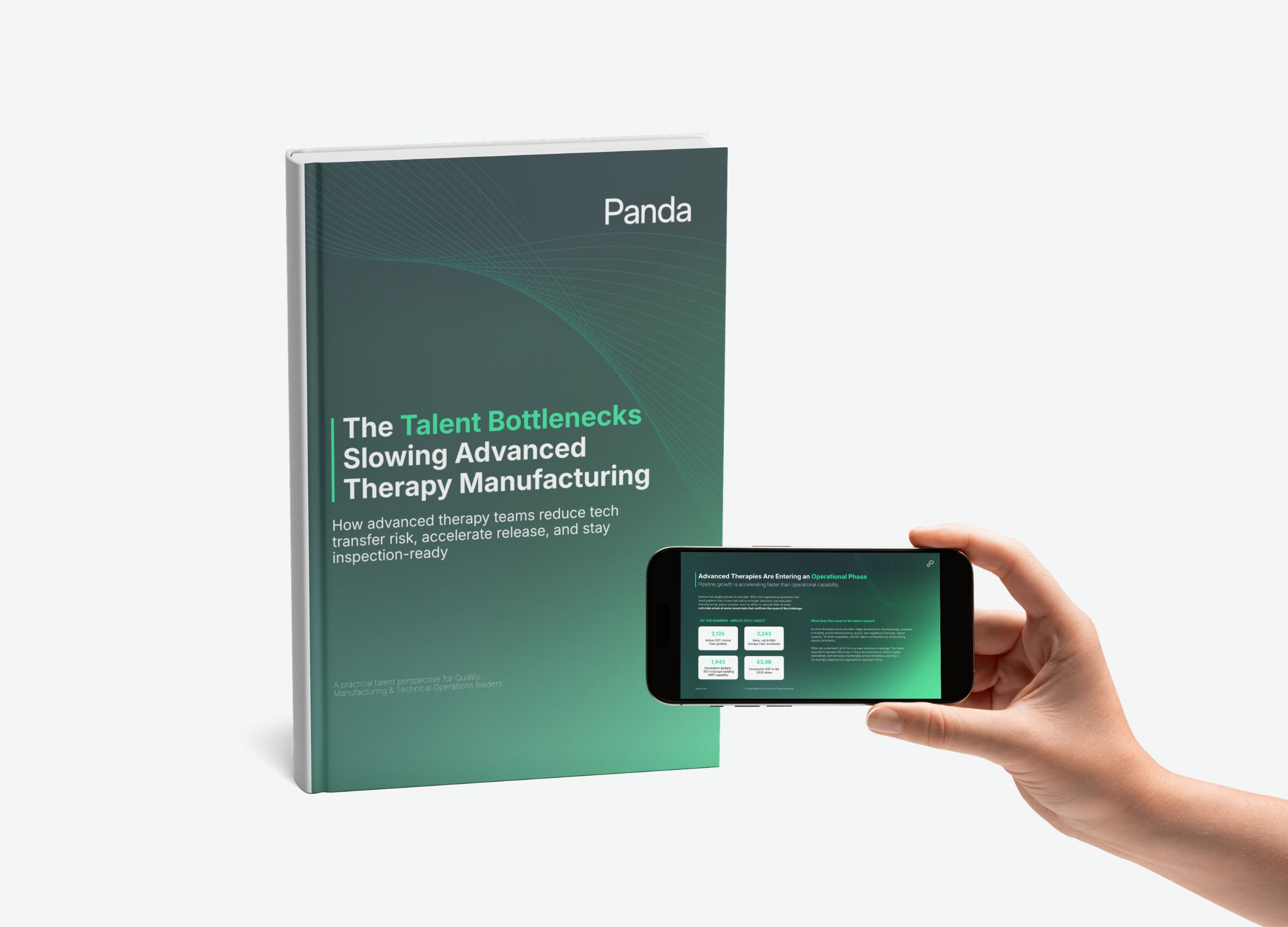
The Talent Bottlenecks Slowing Advanced Therapy Manufacturing  Background Image

Why Talent Is Now the Critical Path in Advanced Therapy Delivery

The science behind advanced therapies has largely proved its principle. What now determines whether a programme reaches patients is not discovery, it is the ability to manufacture, release, and scale reliably under regulatory scrutiny.

Across Europe, the numbers reflect how fast this is moving. There are over 3,200 cell, gene, and RNA therapy trials currently ongoing worldwide, and nearly 2,000 developers globally are building GMP capability, many for the first time. Investment is accelerating ahead of operational readiness, and the pressure is landing on manufacturing, quality, and technical operations teams.

What sits beneath this is a structural challenge that does not resolve itself quickly. The professionals capable of leading tech transfer, managing QP batch certification, or navigating comparability through regulatory review are a finite and highly specialised group. As demand grows across multiple programmes simultaneously, the organisations that plan for this early are the ones that stay on track.

The Talent Bottlenecks Slowing Advanced Therapy Manufacturing  Image


How This Guide Will Strengthen Your GMP Project Delivery

Understand which roles from QP and MSAT to Analytical Development and QC create throughput constraints, and where in your development lifecycle the risk is highest.

Gain a practical framework for when to engage key roles across process development, GMP readiness, clinical manufacturing, and commercial scale-up, before transitions introduce risk.

Learn how gaps in MSAT, CMC, and Regulatory Affairs tend to compound across phases, and how leading organisations structure these functions to protect regulatory confidence.

Understand why quality functions are increasingly the limiting factor in batch release timelines, and how to build QP capacity ahead of clinical supply milestones rather than in response to them.

Discover how organisations with successful hiring records are approaching adjacent talent pools from biologics and vaccines and what onboarding structures make those transitions work in practice.

Build visibility of the passive talent market before you need it, so that critical searches are driven by programme planning rather than urgency.

window.lintrk('track', { conversion_id: 26587058 });

Download eBook

Fill in the form to get your free guide